
Roof Decking and Wall Sheathing: Structural Board Basics
Structural boards do their work behind the finish, and that makes their specification easy to undervalue. CDX Pine Plywood is defined by three letters on the page: a C-grade face, a D-grade back, and X for Exterior glue. Dongstar Wood names the uses as furniture manufacturing, interior decoration and structural sheathing, with applications from roof decking to wall sheathing and temporary structures.
Key takeaways
- CDX means C-grade face, D-grade back, X for Exterior glue: the grade of the visible face and the glue that holds the core.
- Roof decking, wall sheathing, subfloors and underlayment are the structural positions the board is designed for.
- The exterior glue resists moisture and rain during construction phases but is not a permanent weather rating.
- Cross-laminated veneer structure from pine reduces warping and splitting under load across the panel.
What the letters C, D and X mean
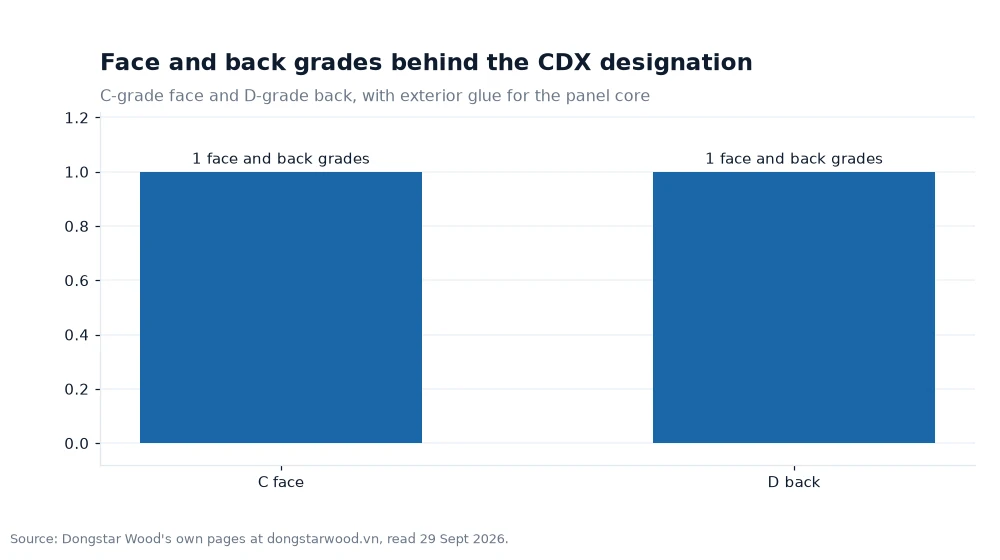
The page defines CDX as three letters that each answer a different question. The first letter describes the face: a C-grade face is smooth and sound, with more variation and knots than an A or B grade but enough quality to serve behind a finish. The second letter describes the back: a D-grade back is the rougher side, the one that does not face the room. The third letter describes the glue: X for Exterior, meaning the adhesive system is formulated to resist moisture during construction phases.
That last letter is the one buyers most often mistake. Exterior glue does not mean the panel is a weatherproof product; it means the glue system can handle temporary exposure to rain and damp on a building site. The difference is practical rather than semantic: a board with exterior glue will survive a construction programme where it is left uncovered for weeks; a board with interior glue will swell and delaminate in the same conditions. The X is the difference between a structural sheathing that survives the build and one that has to be torn out.
Roof decking and underlayment
The named applications on the product page begin with roof decking: shingle and tile underlayment, where the board sits under the roofing material and provides the flat surface that the tiles or shingles fix to. The board's job in that position is mechanical rather than decorative. It has to stay flat under thermal movement, resist the nails and screws that fix the roofing, and hold the weight of the tiles and anyone who walks on the roof during installation.
The cross-laminated structure of pine veneers is what makes this possible. The plies run at right angles to each other, and that alternation resists the cupping and splitting that a solid board would suffer in the same position. The panel's strength is not a single number; it is a geometry, and the geometry is what lets it sit on the roof structure and hold its shape through the seasons.
Wall sheathing, subfloors and indoor frames
Wall sheathing is the board behind the exterior cladding, where the panel's job is to keep the wall straight, hold the screws for the cladding and resist racking loads. Subfloor is the board under carpet, laminate or vinyl, where the panel's job is to provide a flat, stable surface that does not creak underfoot. Indoor frames use the same board for structural bracing, where the panel's rigidity keeps the frame square.
The product page lists these as indoor uses, and the reason is the glue system: the board is best suited where panels are not permanently exposed to weather. A subfloor under a carpet, a wall sheathing behind a cladding system, a frame brace inside a building — these are the positions the board is designed for, and the exterior glue is there to survive the construction phase rather than the service phase.
Temporary structures, barriers and crating
The product page names construction barriers, hoarding, fencing, temporary floors and industrial crating as uses. These are the positions where the board's low cost and structural rigidity make it the logical choice: the panel does not have to last decades, it has to last the construction programme and then be removed. Hoarding is the board that hides a building site from the street; temporary floors are the ones that let trades walk on a structure that is not yet finished; crating is the protection that moves the product between factories.
For crating, the board's advantage is weight: pine is lighter than hardwood, the cross-lamination keeps it rigid, and the exterior glue handles the condensation that forms inside a container on a long sea route. Heavy-duty crates, pallets and industrial packaging are the named applications, and the board fills them because it is strong enough to protect the product and light enough not to waste the container's weight allowance.
Moisture behaviour during construction
The product page is precise about this: the exterior glue resists moisture and rain during construction phases, and the board is best suited where panels are not permanently exposed to weather. That sentence is the specification limit. A CDX panel on a roof that is covered within a few weeks of installation will perform; a CDX panel left on an open deck through a winter of rain will suffer.
The practical consequence is a scheduling decision. On a tight build, the panels go down and the covering follows. On a loose build, the panels go down and rain follows, and the builder has to decide whether the temporary exposure is within the glue's tolerance. The published position — exterior glue for construction phases, not for permanent exposure — is the answer, and it is the answer that should be written into the project programme.
| Input | Published position | What it protects |
|---|---|---|
| Face grade | C-grade face | Smooth enough for the visible side of the board |
| Back grade | D-grade back | The rougher side that does not face the room |
| Glue class | X — Exterior | Moisture resistance during construction phases |
| Structure | Cross-laminated pine veneers | Resistance to warping and splitting under load |
| Limit | Not for permanent weather exposure | Scheduling the covering within the build programme |
Worked example: deck area per sheet
Example: a 1220 × 2440 mm sheet covers 1.22 m × 2.44 m = 2.9768 m² of roof deck. Forty sheets therefore cover 40 × 2.9768 = 119.072 m² of decking, which is a modest residential roof. The builder who orders those forty sheets is ordering a stack that will sit on the roof for the weeks between laying and covering, and the exterior glue is the specification that keeps that stack usable.
Example: the same area checks the subfloor. A room of 50 m² needs 50 ÷ 2.9768 = 16.79, so roughly seventeen sheets, and the offcuts from the wall sheathing of the same house can be cut into the partitions. Both calculations use published sizes as planning estimates labelled as examples, and they demonstrate why the board specification and the schedule have to be fixed together.
Frequently asked questions
What does the X in CDX stand for?
The page defines CDX as a C-grade face, a D-grade back and X for Exterior glue. The exterior glue is what separates this board from an interior panel.
Where is CDX board commonly used indoors?
The page names subfloors, wall bracing and structural frames as common indoor uses, with subfloor panels going under carpet, laminate and vinyl. Indoor use is common even though the glue is an exterior grade.
Can CDX panels stay outside permanently?
No. The product page states the board is not intended for permanent exposure to weather; the exterior glue resists moisture and rain during construction phases, and panels are best suited where they are not permanently exposed.
From the letters to a project programme
A CDX specification is a scheduling document as much as a materials document. The commercial plywood category shows the interior panels that take the finish once the sheathing is hidden, and the company's own profile reveals the factory and the accreditation portfolio behind both. With the grade, the glue class and the schedule fixed, the panels that arrive at site are the ones the builder can plan around.
Every number in this piece was drawn from Dongstar Wood's product listings read 29 Sept 2026[1].