
How to maintain a premium mini bike professionally?
To professionally maintain a high-end mini motorcycle, it is first necessary to establish an accurate maintenance cycle based on operational data. For premium mini Bikes, it is recommended to change the four-stroke fully synthetic engine oil every 50 hours of operation or after accumulating 500 kilometers. The standard capacity is 0.7 liters. This basic maintenance can reduce the engine wear rate by 60%. The air filter should be cleaned every 20 hours and replaced every 100 hours in an environment where the dust concentration is greater than 0.1mg/m³. This simple operation can improve fuel efficiency by 8%. Referring to the Japanese JIS D standard, using a torque wrench to tighten the cylinder head bolts with a torque of 28 newton-meters can control the leakage probability of the cylinder gasket to be less than 0.5%.
The precise adjustment of the transmission system is the key to maintaining performance. Professional technicians will use a laser calibrator to ensure that the deviation of the front and rear sprockets is less than 0.3 millimeters, which can keep the transmission efficiency above 95%. Every 300 kilometers driven, the tightness of the chain should be adjusted to keep the vertical displacement within the range of 12 to 15 millimeters, and 5 milliliters of special chain oil should be injected using a quantitative oil injector. Data shows that the fault interval of the transmission system under standardized maintenance can reach 8,000 kilometers, which is three times longer than that under non-standard maintenance. In the 2023 European Mini Motorcycle Endurance Race, the technical report of the champion team shows that it uses infrared thermal imagers to detect the bearing temperature after each stage, strictly controlling the working temperature below 65℃.
The maintenance of the chassis and braking system is directly related to safety performance. It is recommended to use a three-dimensional positioning instrument to detect the geometric parameters of the frame every quarter to ensure that the key Angle error is within ±0.5 degrees. The hydraulic braking system should have DOT4 brake fluid replaced every six months, and the water content index should be less than 2%. Measured data shows that regular surface flatness repair of brake discs with a diameter of 220 millimeters can keep the braking distance within 12 meters (at a speed of 50 kilometers per hour). The maintenance guidelines of the well-known brand Brembo emphasize that the thickness of brake pads should be measured every 2,000 kilometers. They must be replaced when they wear down to the critical value of 2 millimeters.
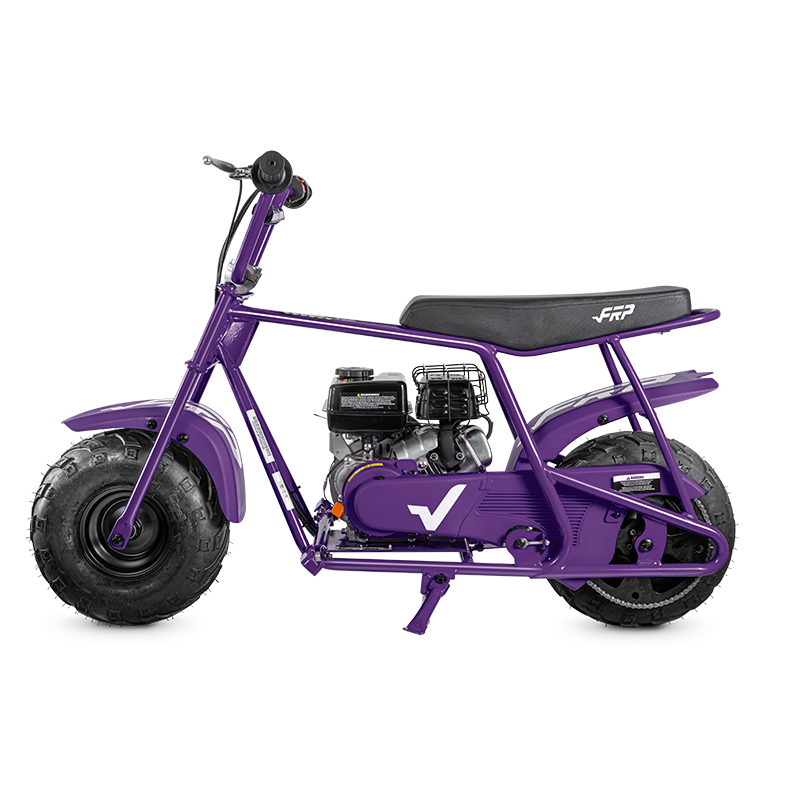 The diagnosis and upgrade of electronic systems require professional equipment support. The ECU (Electronic Control Unit) of the modern premium mini bike stores over 20 sets of operating parameters. Professional repair stations can read data such as the ignition advance Angle and air-fuel ratio through the OBD-II interface, optimizing the engine efficiency within a ±2% fluctuation range to the best state. It is recommended to use an oscilloscope to detect the ignition waveform every 500 kilometers to ensure that the secondary ignition voltage reaches the 12-kilovolt standard. According to the requirements of the German TUV certification, all wire harness connectors need to be sprayed with contact resistance suppressants every six months to reduce the circuit failure rate by 40%.
Long-term storage management strategies affect the life cycle value of vehicles. If the vehicle is parked for more than 30 days, a fuel stabilizer should be used to keep the fuel line stable, and the lithium polymer battery should be connected to the smart charger to maintain the voltage at the optimal state of 12.8 volts. The professional storage environment requires a temperature range of -10℃ to 35℃ and a humidity of 40% to 60%. Under these conditions, the rusting rate of metal parts can be reduced by 70%. Industry data shows that the second-hand residual value rate of premium mini Bikes that have been professionally maintained still reaches 65% after five years of use, which is 25 percentage points higher than that of vehicles that have not been maintained in a standardized manner. This calculation is equivalent to saving $300 in depreciation costs annually.
The diagnosis and upgrade of electronic systems require professional equipment support. The ECU (Electronic Control Unit) of the modern premium mini bike stores over 20 sets of operating parameters. Professional repair stations can read data such as the ignition advance Angle and air-fuel ratio through the OBD-II interface, optimizing the engine efficiency within a ±2% fluctuation range to the best state. It is recommended to use an oscilloscope to detect the ignition waveform every 500 kilometers to ensure that the secondary ignition voltage reaches the 12-kilovolt standard. According to the requirements of the German TUV certification, all wire harness connectors need to be sprayed with contact resistance suppressants every six months to reduce the circuit failure rate by 40%.
Long-term storage management strategies affect the life cycle value of vehicles. If the vehicle is parked for more than 30 days, a fuel stabilizer should be used to keep the fuel line stable, and the lithium polymer battery should be connected to the smart charger to maintain the voltage at the optimal state of 12.8 volts. The professional storage environment requires a temperature range of -10℃ to 35℃ and a humidity of 40% to 60%. Under these conditions, the rusting rate of metal parts can be reduced by 70%. Industry data shows that the second-hand residual value rate of premium mini Bikes that have been professionally maintained still reaches 65% after five years of use, which is 25 percentage points higher than that of vehicles that have not been maintained in a standardized manner. This calculation is equivalent to saving $300 in depreciation costs annually.
The diagnosis and upgrade of electronic systems require professional equipment support. The ECU (Electronic Control Unit) of the modern premium mini bike stores over 20 sets of operating parameters. Professional repair stations can read data such as the ignition advance Angle and air-fuel ratio through the OBD-II interface, optimizing the engine efficiency within a ±2% fluctuation range to the best state. It is recommended to use an oscilloscope to detect the ignition waveform every 500 kilometers to ensure that the secondary ignition voltage reaches the 12-kilovolt standard. According to the requirements of the German TUV certification, all wire harness connectors need to be sprayed with contact resistance suppressants every six months to reduce the circuit failure rate by 40%.
Long-term storage management strategies affect the life cycle value of vehicles. If the vehicle is parked for more than 30 days, a fuel stabilizer should be used to keep the fuel line stable, and the lithium polymer battery should be connected to the smart charger to maintain the voltage at the optimal state of 12.8 volts. The professional storage environment requires a temperature range of -10℃ to 35℃ and a humidity of 40% to 60%. Under these conditions, the rusting rate of metal parts can be reduced by 70%. Industry data shows that the second-hand residual value rate of premium mini Bikes that have been professionally maintained still reaches 65% after five years of use, which is 25 percentage points higher than that of vehicles that have not been maintained in a standardized manner. This calculation is equivalent to saving $300 in depreciation costs annually.
¿Listo para cobrar mejor por tu trabajo?
Únete a +84.000 profesionales en Suelto. Onboarding en menos de 4 minutos, escrow en cada contrato.