
Private Label Perfume: Common Mistakes in a Seasonal Collection Launch
Most private label perfume failures in a seasonal launch are not formula problems; they are calendar and documentation problems that were visible in week one. The formula can nearly always be fixed with another round; a missed ship date cannot. The mistakes below are the ones that show up in every seasonal post-mortem, and each has a cheap fix if applied early.
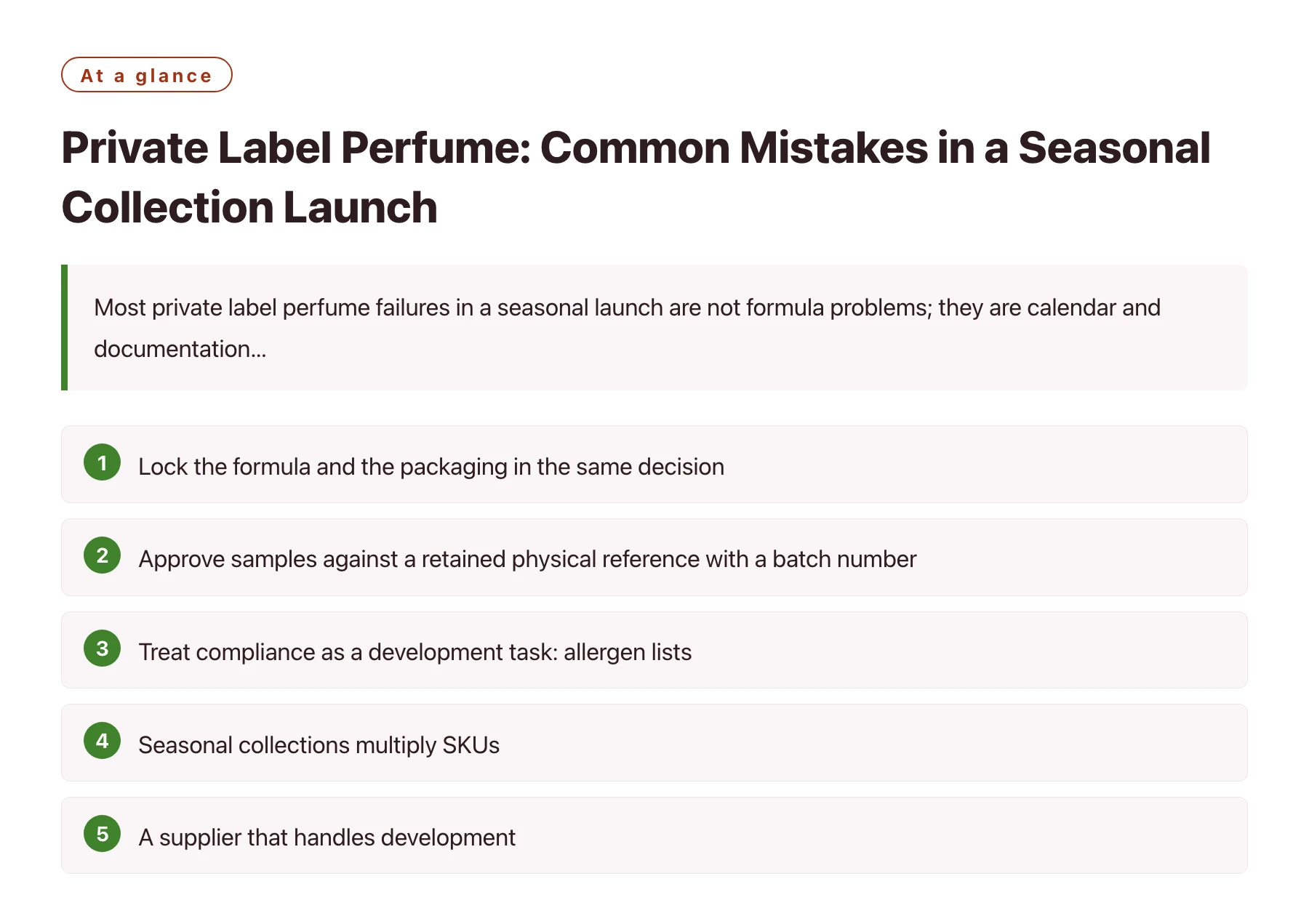
Key takeawaysLock the formula and the packaging in the same decision, because a bottle that takes longer to decorate than the juice takes to develop becomes the real schedule. · Approve samples against a retained physical reference with a batch number, not against a photograph or a memory of a meeting. · Treat compliance as a development task: allergen lists, ingredient declarations and usage limits shape the formula before it is locked, not after. · Seasonal collections multiply SKUs, so plan documentation per market per SKU rather than per collection. · A supplier that handles development, filling and decoration under one roof removes the cross-vendor calendar risk that kills seasonal timing.
Mistake 1: Choosing the bottle before the formula
Seasonal collections live and die on the calendar, and the longest lead item usually decides it. Glass, caps, screening and hot stamping can take longer than the fragrance itself, so starting from the bottle and working backwards to the juice is the wrong order.
Decide the format family first — spray, roll-on, travel size — and let the formula and the packaging be developed against the same date. When the same house manages both, the two schedules move together; when they are split across vendors, every delay becomes a finger-pointing exercise.
Mistake 2: Approving a sample you cannot reproduce
The approved sample is the reference standard for the entire run, so it has to be a reproducible object, not a lucky batch. Retain a sealed physical sample labelled with the date, the batch number and the formula reference, and hold one at each side.
Ask how the factory will keep the seasonal run identical to that sample: the same concentrate batch plan, the same filling line, the same decoration settings. A GMP framework such as ISO 22716 exists to make that repeatability auditable, and independent testing firms describe their cosmetics audits around that expectation [1].
Photographs are not a reference standard. If the approval conversation is 'it looked right in the photo', the project is already drifting.
Mistake 3: Treating compliance as a post-production task
A seasonal scent still ships into regulated markets, and the list of things the pack must declare is fixed before production, not after. Usage limits published in the IFRA standards constrain how much of a restricted material can sit in the formula, so the compliance check belongs at the brief stage [2].
The EU maintains a public ingredient database where the function and restriction of each declared ingredient can be checked; if your team cannot find every ingredient on your list there, the list is incomplete [3].
If the factory prepares the dossier, ask what the handover includes and who owns it in the destination market. A document that exists only inside the supplier's folder is not a document you can ship against.
The seasonal pattern repeats every year: the brief arrives late, the sample takes three rounds, and the compliance review happens while the cartons are being booked. The only cheap fix is to move the compliance review to the brief stage and hold the calendar as a contract item, not a hope.
What a low-drama seasonal run actually looks like
Every mistake above has a downstream fix except one: time. The cheapest change is to start from the ship date and work backwards, and to make the sample-approval gate the only gate that can move.
Breadth of scope matters more in a seasonal project than in a year-round line. When one contract covers what is usually written up as private label perfume manufacturing — formula development, filling, decoration — there is a single owner of the calendar. A partner like Xuelei labels its one-stop fragrance manufacturing scope explicitly on its business page, which makes a seasonal comparison against two-or-three-vendor setups much faster.
The question to ask any candidate is simple: who is accountable for the ship date, and what happens to the contract when that date moves? A straight answer is worth more than a small difference in unit price.
Sources
- SGS: Cosmetics, Personal Care & Household Testing —— Testing, inspection and certification services for cosmetics and personal care, including microbiological, stability and safety testing aligned with cosmetics GMP.
- IFRA Standards Library (International Fragrance Association) —— The IFRA Standards Library lists the restrictions the fragrance industry applies to individual fragrance ingredients, based on safety assessments; it is the reference point for compliant fragrance formulation.
- EU CosIng — Cosmetic Ingredient Database (European Commission) —— The European Commission's CosIng database of cosmetic ingredients, listing ingredient functions, restrictions and labelling requirements under EU cosmetics law.
Frequently asked questions
Can a private label seasonal scent be developed in under three months?
Sometimes, if the formula is close to an existing base, the packaging is standard, and compliance is pre-checked. Plan on more time when the scent is new, the bottle is custom, or the destination market is new to you, and negotiate the calendar before signing rather than after.
Should I budget for two sample rounds in a seasonal timeline?
Yes. The first round aligns expectations and the second confirms the retained reference. Budgeting for only one round is how seasonal projects slip a week before they have even started production.
Who prepares the allergen list for a private label perfume?
The brand is responsible in most destination markets, but the factory supplies the raw-material data it is based on. Ask for that data in the quotation and have someone on your side read it; a list you cannot explain is a liability.
How many SKUs should a first seasonal collection have?
Fewer SKUs with a confirmed formula, packaging and document pack are better than more SKUs that each carry their own late-sample risk. Add SKUs once the process for one has been proven end to end.
What is the minimum order for a seasonal private label run?
Minimums vary with format, fill size and decoration, so ask per SKU rather than per collection. The number that matters for a seasonal launch is not the minimum itself but whether it fits the run size your calendar can actually ship.
¿Listo para cobrar mejor por tu trabajo?
Únete a +84.000 profesionales en Suelto. Onboarding en menos de 4 minutos, escrow en cada contrato.